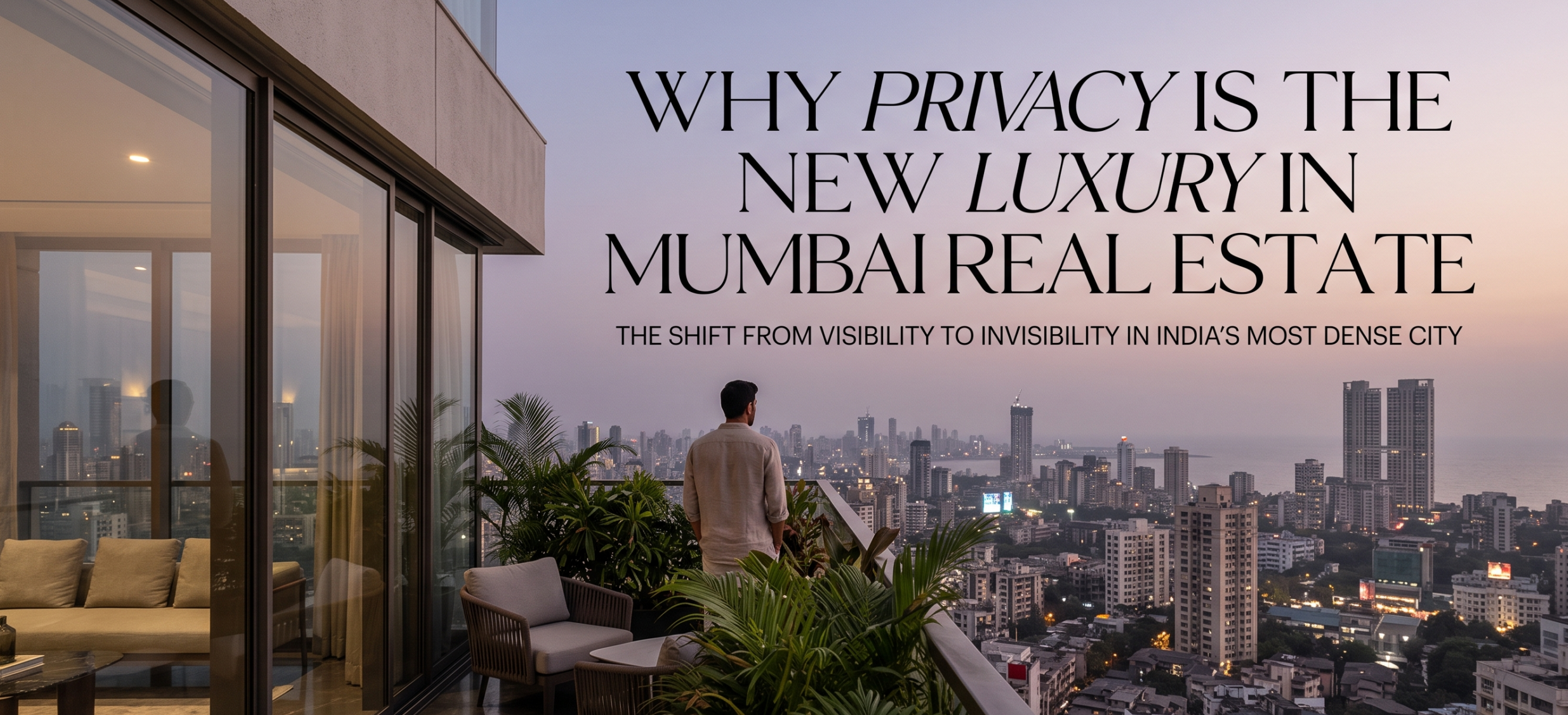
Luxury in Mumbai Real Estate
In a city where twenty million people share every inch of available land, the rarest thing money can buy is no longer space — it is silence, seclusion, and anonymity. For decades, luxury in Mumbai real estate was defined by a single word: address. A sea-facing view in Malabar Hill, a coveted postcode in Bandra, a tower in Worli overlooking the skyline — these were the markers of prestige. Square footage, imported marble, and a prominent location formed the traditional currency of status in the city’s property market.
That currency is now being redefined. Buyers who can afford almost anything are increasingly prioritising something that wealth was once assumed to guarantee automatically, but no longer does: privacy. The ability to remain unseen, unheard, and undisturbed has become one of the rarest — and most expensive — amenities a home can offer.
From Visibility to Invisibility: A Changing Definition of Prestige
Traditional luxury real estate in Mumbai has long sold itself through visibility — the tallest building, the most recognisable facade, an address impressive enough to precede its owner. Yet visibility carries a cost. A high-profile building draws more foot traffic, more staff, more deliveries, and, ultimately, more attention. In an age of smartphone cameras, social media, and constant news coverage, being easily identifiable has shifted from a status symbol to a genuine liability.
In its place, a quieter form of prestige has emerged: buildings without prominent signage, entrances set away from the main road, private elevators opening directly into individual floors, and lobbies designed to reveal as little as possible to those not meant to be there. The new measure of luxury is not “how grand does this appear” but “how completely can this remain unnoticed.”
What Is Driving the Shift
A city under constant observation. Mumbai’s density makes proximity unavoidable. Thin walls carry conversations between neighbours, domestic staff move between multiple households in a single day, and much of the city’s construction has historically prioritised maximising units per plot over insulation or spacing. As towers grow taller and closer together, genuine privacy becomes mathematically scarcer — and, in turn, more valuable.
A need for anonymity among public figures. Mumbai houses one of India’s largest concentrations of entertainment, sporting, and business elite. For individuals recognised the moment they step outside their homes, privacy is not a preference but a practical necessity. Private elevators, restricted shared amenities, and staff bound by strict confidentiality agreements have become standard requirements rather than optional extras.
The demands of an increasingly digital working life. As high-stakes conversations — negotiations, client meetings, therapy sessions, family discussions — increasingly take place over video calls from home, residences must function as soundproof, uninterruptible workspaces. A striking view carries little value if noise from a neighbouring renovation or nearby construction disrupts every call.
An evolving understanding of security. Visible wealth has always carried some degree of risk in dense urban environments, but growing awareness of digital tracking and online exposure has broadened what security now means. It is no longer limited to gates and guards; it extends to controlling who is even aware of one’s building, floor, or address.
How Privacy Is Reflected in Today’s Listings
Developers and brokers serving Mumbai’s upper tier have begun designing — and marketing — very specific features to meet this demand:
- Private, dedicated elevators serving a single residence rather than a shared bank, ensuring residents never share a lobby with a stranger.
- Segregated service and staff entrances, keeping household staff, deliveries, and maintenance movement entirely separate from residents’ own paths through the building.
- Low-density floor plans, often limited to one or two units per floor and explicitly marketed as having no shared walls.
- Acoustic engineering and soundproofing, treated as a stated specification rather than an afterthought, particularly for professionals working from home.
- Minimally branded buildings, where even identifying which tower a resident occupies requires being told directly.
- Strict confidentiality agreements for staff, especially in developments housing public figures or family offices.
- Biometric and application-based access control, replacing the visitor logbooks once accessible to anyone who asked.
The Price of Being Unseen
This shift is reflected directly in pricing. Units offering low-density, high-privacy configurations in areas such as Malabar Hill, Altamount Road, and select pockets of Bandra and Juhu are commanding significant premiums over larger but more exposed units within the same micro-market. Buyers are, in effect, paying elevated per-square-foot rates for fewer neighbours rather than additional amenities.
This represents a genuine departure from how luxury real estate in India has traditionally been valued — primarily on size, location, and finish quality. Privacy is more difficult to quantify than square footage, but it is proving to be equally, if not more, bankable.
The Neighbourhoods Leading This Shift
The trend is not distributed evenly across the city; certain neighbourhoods have become closely associated with this privacy-led model. Malabar Hill has long been Mumbai’s old-money enclave, but its newer redevelopments emphasise seclusion more deliberately than the bungalows and low-rises that preceded them, largely in response to the increasing activity of the surrounding area. Altamount Road, already known for record per-square-foot prices, has increasingly positioned privacy — rather than scarcity of land alone — as its central selling proposition. Pali Hill and parts of Bandra West, historically valued for their bungalow character, are seeing new developments that attempt to recreate that same sense of enclosure through high boundary walls, landscaping used as a visual buffer, and structures set back from the road to limit sightlines.
Even newer luxury corridors such as Lower Parel and Worli, where towers have traditionally competed on height and skyline views, are witnessing a shift in marketing language. Listings once centred on panoramic views now increasingly lead with phrases such as “single unit per floor” or “private lobby access” — a tacit acknowledgement that visibility from every angle is no longer the primary draw it once was.
The Role of Technology in Enabling Privacy
The same digital environment that has made public figures more exposed than ever is also supplying the tools that allow Mumbai’s wealthiest residents to reclaim their privacy at home. At the centre of this shift is automation — the quiet engine behind almost every privacy feature now considered standard in top-tier developments. Smart access systems now allow residents to issue time-limited digital keys to staff or guests, eliminating the need for physical copies that can be duplicated. Facial recognition and biometric entry have replaced the visitor registers once available for anyone to review. Some developments have gone further, allowing residents to summon a private elevator through a mobile application before they have even parked, minimising time spent in any shared or visible space.
Home automation has similarly evolved from a convenience feature into a privacy tool. Smart glass that shifts from transparent to opaque at the touch of a button, voice-activated blackout systems, and soundproofed rooms designed specifically for video calls are now common requests directed at architects working in this segment. In keeping with the broader trend, the technology itself is designed to remain unobtrusive — its purpose is to recede into the background rather than draw attention.
A Preference Extending Beyond the Ultra-Wealthy
While the most extreme expressions of this trend — entire buildings designed around a single family, or towers without any public-facing amenities — remain confined to the very wealthy, the underlying preference is extending into the broader premium segment as well. Mid-to-upper-tier developments are increasingly advertising fewer units per floor, improved sound insulation, and application-controlled access as selling points, recognising that even buyers with no particular need for anonymity still value not hearing a neighbour’s television through the wall.
Conclusion: What This Means Going Forward
As Mumbai’s skyline continues to rise and its density continues to intensify, a clear pattern is emerging at the heart of the luxury real estate market: the city’s most desirable homes are increasingly those that feel removed from the city itself — insulated, undisturbed, and unseen. Developers who recognise this shift are no longer selling square footage and sea views alone. They are selling the ability to remain private in a city where privacy has never been harder to obtain.
Where visibility was once the ultimate marker of success in Mumbai real estate, discretion has taken its place. In this evolving market, the true measure of luxury is no longer how much attention a home commands, but how completely it allows its owner to avoid it.